

UAE vs Singapore: What Investors Need to Know
Singapore and the UAE have a lot in common. Both have built international reputations around business, connectivity and attracting global talent. Both offer sophisticated infrastructure, internationally recognised financial centres and property markets that attract overseas attention. Yet spend time in Singapore and Dubai, and their differences become apparent.
Singapore is compact, meticulously planned and deeply connected to Asian markets. The UAE offers a broader geographical landscape, from Dubai's commercial districts to Abu Dhabi's cultural attractions and Ras Al Khaimah's expanding waterfront communities.
For investors considering Singapore vs UAE, the decision extends beyond property prices or tax rates. It involves understanding how each market operates, what foreign ownership entails, and whether the destination fits longer-term financial and lifestyle goals.
For international buyers comparing the UAE and Singapore, property ownership is only one part of a broader investment decision.
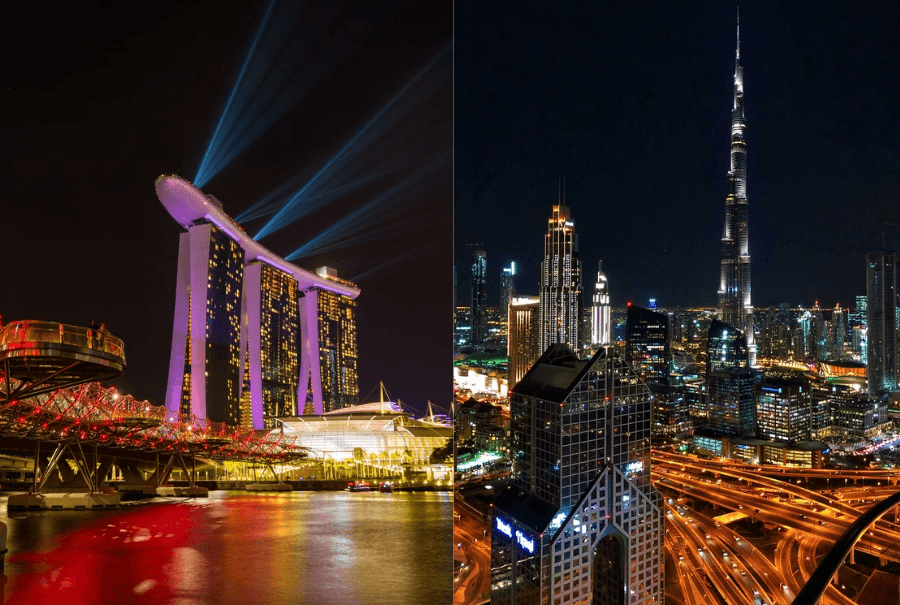
Singapore vs UAE: An Investor's Overview
| Factor | Singapore | UAE |
| Economic positioning | Major Asian financial and commercial hub | International trade, finance and investment hub |
| Foreign property ownership | Condominiums generally accessible; landed homes restricted | Freehold ownership permitted in designated areas |
| Personal income tax | Progressive rates for tax residents | No personal income tax on salaries |
| Corporate tax | Standard rate of 17% | Generally 9% above the applicable taxable-income threshold |
| Residential investment market | Established, tightly regulated | Established and emerging residential destinations |
| Housing and rental market | Established private residential market with regulated foreign ownership | Diverse rental markets across established and emerging communities |
| Business opportunities | Finance, technology, logistics and advanced manufacturing | Real estate, tourism, logistics, finance and technology |
| Banking infrastructure | Established international banking and wealth management centre | Domestic and international banking network with major financial centres |
| Currency framework | Exchange-rate-centred monetary policy | Dirham pegged to the US dollar |
| Lifestyle | Compact, urban, highly connected | Varied urban, coastal and suburban environments |
Sources: Inland Revenue Authority of Singapore (IRAS), Singapore Land Authority, Monetary Authority of Singapore, UAE Federal Tax Authority, Central Bank of the UAE and UAE Government.
Property Investment: Two Different Markets
Property ownership is one of the most significant differences between the destinations. UAE and Singapore real estate markets differ considerably in foreign ownership rules, acquisition costs and residential investment opportunities.
Investing in Singapore Property
Singapore's residential market operates within a tightly regulated framework designed partly to manage housing demand.
Foreign buyers can generally purchase private condominium units without special ownership approval. However, purchasing landed residential property typically requires approval from the Singapore Land Authority.
The larger financial consideration is Additional Buyer's Stamp Duty (ABSD).
As of October 2026, the standard ABSD rate for foreign individuals purchasing residential property is 60%, in addition to ordinary Buyer's Stamp Duty.
Certain buyers, including qualifying US nationals and eligible nationals or permanent residents covered by specific free trade agreements, may receive different treatment. (Source: IRAS – Additional Buyer's Stamp Duty)
Investing in UAE Property
The UAE offers a different ownership framework.
In Dubai, overseas investors can purchase freehold property within designated areas without being UAE residents.
Popular locations include Dubai Marina, Downtown Dubai and Palm Jumeirah, while other emirates offer their own investment zones and ownership regulations.
Dubai's property sale registration fee is generally 4% of the transaction value, with additional administrative and brokerage expenses where applicable. (Source: Dubai Land Department)
Beyond Dubai, emerging destinations such as Al Marjan Island in Ras Al Khaimah are attracting interest through waterfront and branded residential developments.
Projects including BNW Developments' Aqua Arc, La Perla and Taj Wellington Mews illustrate the expanding range of coastal property options available to international buyers.
Housing and Rental Markets: UAE vs Singapore
Housing and rental conditions are important considerations when comparing UAE and Singapore real estate, particularly for investors focused on recurring rental income.
Singapore's housing market includes public housing, private condominiums and landed residential properties. Its rental market serves local households, expatriate professionals and international families. However, foreign investors generally face restrictions on purchasing certain residential property types, making private condominiums a more accessible option.
In the UAE, rental demand varies across emirates and communities. Dubai offers an established apartment and villa rental market, while Abu Dhabi caters to a mix of professionals and families. Ras Al Khaimah is developing a distinct residential market supported by tourism, hospitality investment and waterfront communities.
Investors should also consider the differences between long-term residential leasing and short-term holiday rentals. Although holiday accommodation may offer additional income opportunities in tourism-oriented locations, occupancy levels, management costs and licensing requirements can influence returns.
In both destinations, evaluating achievable rents, vacancy periods, maintenance costs and property management expenses is essential before estimating net rental yields.
Taxation: Understanding the Financial Implications
Tax treatment can significantly influence investment planning, although headline rates rarely tell the complete story.
Singapore applies progressive personal income tax rates, with the highest resident rate currently at 24%. Its standard corporate income tax rate is 17%, subject to applicable exemptions and rebates.
The UAE does not levy personal income tax on ordinary employment salaries. Its standard corporate tax framework generally applies 0% to the first AED 375,000 of taxable income and 9% above that threshold, subject to specific rules and exceptions. (Sources: IRAS and UAE Federal Tax Authority)
For international investors, tax residency remains important. Income earned overseas may still be taxable in another jurisdiction, depending on citizenship, residency and applicable tax treaties.
Professional cross-border tax advice is essential before structuring investments.
Singapore vs UAE Living: What Is Everyday Life Like?
Financial opportunities matter, but so does the environment in which investors and their families choose to live.
Living in Singapore
Singapore is known for its efficient public transport, established healthcare services, international schools and convenient access to Southeast Asia.
Its compact geography makes commuting relatively straightforward, particularly for residents living near MRT connections.
However, housing, private education and car ownership can represent substantial household expenses.
For families accustomed to highly organised urban living, Singapore offers considerable convenience.
Living in the UAE
The UAE offers a wider range of residential environments.
Dubai appeals to professionals seeking a cosmopolitan lifestyle, while Abu Dhabi offers established family neighbourhoods and cultural attractions.
Ras Al Khaimah provides a different experience, combining beaches, mountains and expanding waterfront communities.
Housing costs vary considerably across the emirates and neighbourhoods, allowing residents to explore different combinations of space, amenities and lifestyle.
For investors planning to relocate, comparing actual housing, education, healthcare and transport expenses is more useful than relying on broad national averages.
Business and Investment Opportunities: UAE and Singapore
Singapore's location makes it particularly relevant for businesses operating across Southeast Asia.
Its established financial services ecosystem, commercial infrastructure and regulatory environment support a wide range of international companies.
Beyond property, Singapore offers investment opportunities across financial services, technology, logistics, advanced manufacturing and asset management. Its established regulatory environment and access to Asian markets make it an important destination for international businesses and institutional investors.
The UAE occupies a strategic position between Asia, Europe and Africa, with Dubai and Abu Dhabi serving as major centres for trade, finance, logistics and tourism.
Business and investment opportunities in the UAE extend across real estate, hospitality, renewable energy, logistics, financial services and technology. Its network of economic free zones and investment-focused initiatives provides different options for international entrepreneurs and companies.
The UAE's property sector also offers investors exposure to established urban markets and emerging destinations. Dubai's mature residential communities and Ras Al Khaimah's tourism-led development illustrate how opportunities can differ within the same country.
For entrepreneurs, the decision often depends on customer geography, licensing requirements, workforce availability and the sector in which they operate.
Both jurisdictions offer established business environments, but company formation, ownership structures and regulatory obligations should be examined individually.
Banking and Financial Infrastructure: Comparing UAE and Singapore
Banking accessibility and financial infrastructure are important considerations for international investors managing assets across borders.
Singapore is a major international banking and wealth management centre, with an established financial ecosystem serving individuals, businesses and institutional investors. Its financial sector is regulated by the Monetary Authority of Singapore (MAS), which oversees banking, financial markets and related financial services.
The UAE also has a developed banking sector, supported by domestic and international financial institutions. The Central Bank of the UAE regulates the country's banking system, while financial centres such as the Dubai International Financial Centre (DIFC) and Abu Dhabi Global Market (ADGM) support international financial and investment activity under their respective regulatory frameworks.
For property investors, practical considerations include mortgage eligibility, financing costs, account-opening requirements and the ability to transfer funds internationally. Non-resident banking and mortgage arrangements may differ from those available to residents in either destination.
Currency is another distinction. The UAE dirham is pegged to the US dollar, while the Singapore dollar operates under an exchange-rate-centred monetary policy framework. International investors should consider how currency movements could affect investment costs, rental income and returns when converted into their home currency.
Ultimately, both UAE and Singapore offer sophisticated financial infrastructure, but banking access, borrowing conditions and investment requirements should be assessed according to individual circumstances.
Residency and Long-Term Planning
Neither destination automatically grants permanent residency simply because someone purchases property.
Singapore's permanent residency framework involves a separate application and assessment process.
In the UAE, eligible property investors may qualify for long-term residence options, including Golden Residency, subject to investment thresholds and approval requirements.
Investors considering relocation should distinguish between property ownership, permission to reside and long-term immigration status.
These decisions are related, but not interchangeable.
UAE vs Singapore: Where Should Investors Focus?
The most useful comparison begins with the investor's objectives.
Singapore offers access to an established Asian financial centre, a highly structured urban environment and a regulated residential property market.
The UAE combines international business connectivity with foreign freehold ownership opportunities, varied residential destinations and a different personal taxation framework.
For property-focused investors, acquisition costs, ownership restrictions and realistic rental performance deserve particular attention. For entrepreneurs, regulatory requirements and market access may carry greater weight.
And for those comparing Singapore vs UAE living, the decision becomes equally personal: the kind of home, community and daily routine they want.
Beyond taxation and property ownership, investors comparing the UAE and Singapore should also examine rental market conditions, banking accessibility, business opportunities and the practical costs of managing investments internationally. Together, these factors provide a more complete picture of each destination's long-term investment potential.
Ultimately, both markets offer meaningful opportunities. The stronger investment decision comes from understanding their differences and choosing the destination that aligns with your financial strategy, lifestyle preferences and long-term plans.
For investors considering property ownership in the UAE, exploring the right developer is just as important as choosing the right location. BNW Developments offers a portfolio of premium residential and branded developments across emerging destinations such as Ras Al Khaimah, providing international buyers with opportunities to explore waterfront living and thoughtfully designed properties in one of the UAE's evolving real estate markets.